Introduction
Software has become the backbone of modern businesses. Whether you're running a startup, MSME, manufacturing company, or service-based business, the software you choose directly impacts productivity, customer experience, operational efficiency, and profitability.
One of the biggest decisions entrepreneurs face today is:
Should you use SaaS software or own the source code through custom software development?
The right choice depends on your budget, growth plans, business complexity, and how important technology is to your competitive advantage.
What is SaaS?
SaaS (Software as a Service) is a software delivery model where businesses pay a subscription fee to access software hosted and maintained by a third-party provider.
Instead of purchasing software outright, you rent access to it online.
Common SaaS Examples
CRM Platforms
HR Management Systems
Accounting Software
Project Management Tools
Email Marketing Platforms
Advantages of SaaS
Lower Upfront Costs
Minimal initial investment
Monthly or annual subscription model
Faster Implementation
Ready to use almost immediately
No development time required
Automatic Updates
Security patches
Feature enhancements
Bug fixes handled by the vendor
Accessibility
Access from anywhere with an internet connection
Reduced Technical Burden
No need for an in-house development team
Vendor handles maintenance
Limitations of SaaS
Limited customization options
Dependence on vendor roadmaps
Recurring subscription costs
Vendor lock-in risks
Integration limitations
As businesses grow, these challenges often become more noticeable.
What Does "Owning the Code" Mean?
Owning the code means your business owns:
The source code
Intellectual property
Software functionality
Future development rights
This is usually achieved through custom software development.
Benefits of Owning the Code
Complete Business Control
You control:
Features
Development priorities
Integrations
User experience
Unlimited Customization
Software adapts to your workflow
Not the other way around
Full Data Ownership
Greater control over:
Data storage
Security
Compliance
Reporting
Competitive Advantage
Build capabilities competitors cannot easily replicate.
Long-Term Value
The software becomes a business asset, similar to:
Equipment
Patents
Trademarks
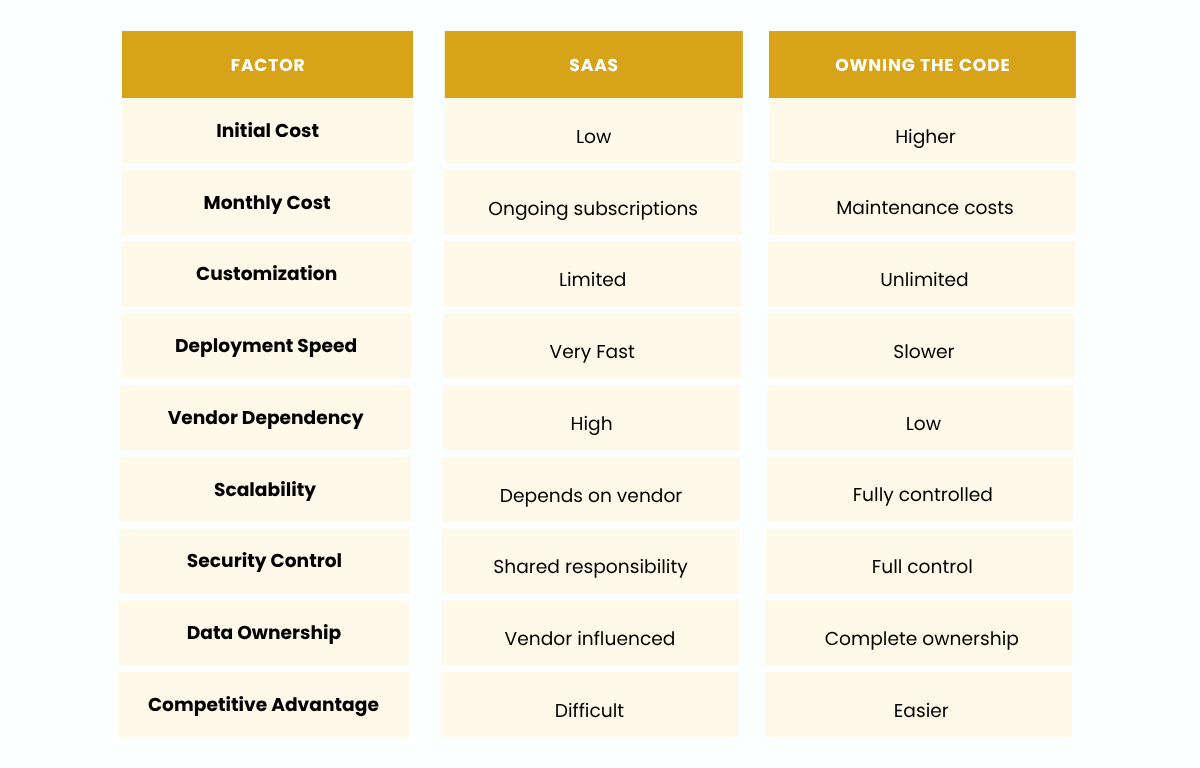
SaaS vs Owning the Code: Quick Comparison
Advantages of SaaS for Entrepreneurs
SaaS is often ideal for:
Early-Stage Startups
Lower risk
Faster launch
Small Teams
No technical expertise required
Budget-Conscious Businesses
Predictable monthly costs
Market Validation
Quickly test business ideas
Standardized Processes
Works well when operations follow industry norms
Advantages of Owning the Code
Custom software becomes attractive when technology is central to growth.
Complete Control
No dependence on third-party roadmaps
Business Differentiation
Unique features
Unique workflows
Better Scalability
Grow without software limitations
Long-Term Cost Benefits
Avoid increasing subscription costs
Strategic Asset Creation
Software becomes part of company valuation
Hidden Costs Entrepreneurs Often Ignore
Many businesses compare only upfront costs.
The real costs often appear later.
SaaS Hidden Costs
Subscription Creep
Costs increase with:
More users
Additional modules
Extra storage
Premium features
Vendor Lock-In
Difficulties when switching providers due to:
Proprietary workflows
Data structures
Integrations
Migration Costs
Changing systems may require:
Data migration
Employee retraining
Process redesign
Custom Software Hidden Costs
Development Expenses
Design
Development
Testing
Documentation
Ongoing Maintenance
Security updates
Server management
Performance optimization
Technical support
When is SaaS the Best Option?
Choose SaaS when:
✅ You need speed
✅ You have limited budget
✅ You are validating a business idea
✅ Your processes are relatively standard
✅ You want minimal technical responsibility
When Should You Own the Code?
Choose custom software when:
✅ Your workflows are unique
✅ Technology is a competitive advantage
✅ Software is critical to daily operations
✅ You require deep customization
✅ You are planning long-term scalability
Hybrid Approach: Best of Both Worlds
Many businesses successfully combine SaaS and custom software.
How It Works
Use SaaS For:
Payroll
HR
Accounting
Communication
Use Custom Software For:
Operations
Customer Experience
Industry-Specific Workflows
Core Business Processes
Example
An e-commerce business may use:
SaaS
HR Software
Accounting Software
Custom Software
Order Management System
Inventory Workflow Automation
This creates a balance between speed, cost, and control.
Real Business Scenarios
Startup Founder
Needs quick execution and market validation.
Best Choice: SaaS
Manufacturing Company
Requires specialized workflows and production processes.
Best Choice: Owning the Code
Service-Based Business
Typically follows standardized processes.
Best Choice: SaaS or Hybrid
Software Company
Technology is the product itself.
Best Choice: Owning the Code
Key Takeaways
SaaS offers speed, simplicity, and affordability.
Owning the code provides flexibility, control, and long-term value.
Startups often benefit from SaaS initially.
Growing businesses may outgrow SaaS limitations.
Both models have hidden costs.
Hybrid approaches are becoming increasingly popular.
The best decision depends on business goals, not technology trends.
Conclusion
There is no one-size-fits-all answer.
If your priority is speed, simplicity, and lower upfront investment, SaaS is often the better choice.
If your priority is control, scalability, customization, and long-term competitive advantage, owning the code can deliver greater strategic value.
For many modern businesses, the most practical solution is a hybrid approach—using SaaS for common functions while investing in custom software where differentiation matters most.