The foundation of contemporary businesses is now software. The software you select can have a direct impact on productivity, customer experience, operational efficiency, and profitability, regardless of whether you're managing a startup, manufacturing business, service-based agency, or expanding MSME.
Choosing between Software-as-a-Service (SaaS) and owning the source code through custom software development is one of the most important business software decisions that entrepreneurs must make today.
SaaS seems like the obvious option at first glance. It requires little technical knowledge, is quick to implement, and is reasonably priced. Owning the code, on the other hand, provides total control, limitless customisation, and long-term strategic benefits.
Which choice is best for your company, then?
The answer is contingent upon your operational complexity, budget, growth plans, and the degree to which software is essential to your competitive advantage.
What is SaaS?
SaaS (Software as a Service) is a software delivery model where businesses pay a subscription fee to access software hosted and maintained by a third-party provider.
Instead of buying software outright, you rent access to it through the internet.
Examples of SaaS Software
CRM platforms
HR management systems
Accounting software
Project management tools
Email marketing platforms
Popular SaaS platforms include customer management systems, payroll software, project collaboration tools, and financial applications.
Advantages of SaaS
Reduced Initial Expenses
The majority of SaaS platforms don't require significant upfront investments because they rely on monthly or yearly subscriptions.
Quicker Execution
SaaS tools can be used by businesses practically instantly.
Updates that happen automatically
The platform is continuously improved by vendors without requiring customers to handle upgrades.
Availability
SaaS applications are accessible to users from any location with an internet connection.
SaaS's limitations
SaaS has limitations even though it's convenient:
Restricted personalisation
Reliance on vendor roadmaps
Continuous subscription fees
Risks of vendor lock-in
Possible difficulties with integration
As many companies expand, these constraints become more apparent.
What Does It Mean to Own the Code?
Owning the code indicates that your company is the owner of the software's functionality, intellectual property, and source code.
This usually entails either hiring a development partner who transfers ownership rights upon completion or creating custom software internally.
Ownership of Custom Software
When the code is yours:
Your company owns the software.
Future development is under your control.
The evolution of features is up to you.
You can change suppliers without forfeiting ownership.
Rights to Intellectual Property
Like equipment, patents, or trademarks, the source code becomes a business asset.
Proprietary software itself becomes one of the most valuable assets in some businesses.
Flexibility and Control
Custom software, in contrast to SaaS platforms, enables companies to:
Create distinctive workflows
Make unique features
Connect to any system
Quickly adjust to evolving needs
SaaS vs Owning the Code: Key Differences
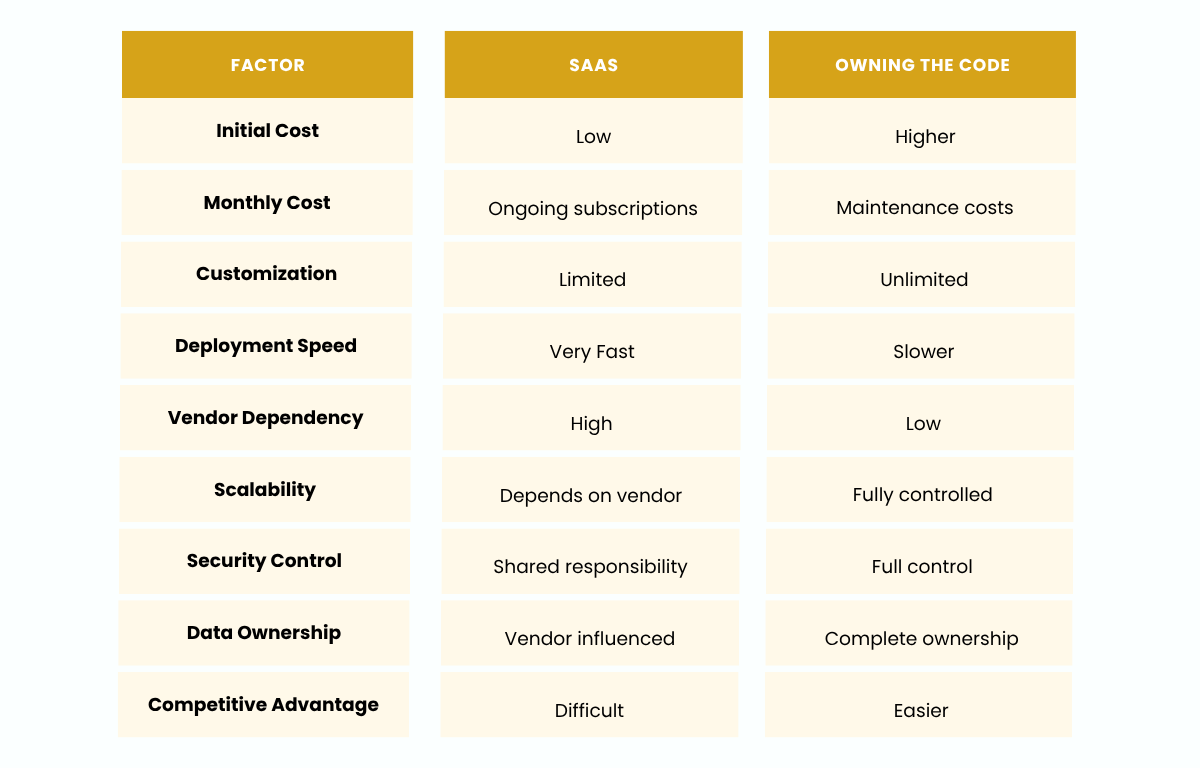
Quick Summary
SaaS frequently prevails if speed and cost are your top priorities.
Owning the code becomes more appealing if strategic control and differentiation are your top priorities.
Advantages of SaaS for Entrepreneurs
For many startups and small businesses, SaaS remains the most practical option.
Lower Upfront Investment
Instead of investing lakhs or even crores into development, entrepreneurs can start with predictable monthly costs.
This reduces risk during the early stages.
Faster Deployment
Most SaaS tools can be implemented within hours or days.
This allows founders to focus on customer acquisition rather than software development.
Automatic Updates
The vendor handles:
Bug fixes
Security patches
Feature releases
Infrastructure management
Entrepreneurs save time and resources.
Lower Technical Burden
No development team is required.
Business owners can focus on operations while the vendor manages the technology.
Ideal for Validation
For startups testing new ideas, SaaS helps validate concepts before making major investments.
Advantages of Owning the Code
For businesses planning long-term growth, software ownership for businesses can provide substantial strategic advantages.
Complete Business Control
You decide:
Features
User experience
Integrations
Development priorities
There is no dependence on external software roadmaps.
Competitive Differentiation
Many businesses use the same SaaS platforms.
Custom software enables unique capabilities competitors cannot easily replicate.
Unlimited Customization
Custom software can mirror your exact processes.
Instead of changing your workflow to fit software, the software adapts to your workflow.
Full Data Ownership
Data is one of the most valuable business assets.
Owning the code provides greater control over:
Data storage
Security
Compliance
Reporting
Long-Term Cost Benefits
Although custom software development requires larger upfront investments, businesses often save money over several years by eliminating escalating subscription costs.
Hidden Costs Entrepreneurs Often Ignore
Many founders compare only upfront costs.
However, hidden expenses often influence the real ROI.
Subscription Creep
A SaaS tool may seem affordable initially.
But costs rise as you add:
Users
Modules
Storage
Advanced features
A system costing ₹10,000 per month can become significantly more expensive over time.
Vendor Lock-In
Switching SaaS providers can be difficult.
Businesses often become dependent on:
Proprietary workflows
Vendor integrations
Data structures
Migration can become costly and disruptive.
Migration Costs
Changing software frequently requires:
Data migration
Employee retraining
Process redesign
These indirect costs are often underestimated.
Development Costs
Custom software requires:
Initial development
Testing
Documentation
Quality assurance
Budgeting properly is essential.
Maintenance Expenses
Owning the code means maintaining:
Servers
Security
Performance
Updates
Entrepreneurs should account for ongoing technical support.
Hidden Costs Entrepreneurs Often Ignore
Many founders compare only upfront costs.
However, hidden expenses often influence the real ROI.
Subscription Creep
A SaaS tool may seem affordable initially.
But costs rise as you add:
Users
Modules
Storage
Advanced features
A system costing ₹10,000 per month can become significantly more expensive over time.
Vendor Lock-In
Switching SaaS providers can be difficult.
Businesses often become dependent on:
Proprietary workflows
Vendor integrations
Data structures
Migration can become costly and disruptive.
Migration Costs
Changing software frequently requires:
Data migration
Employee retraining
Process redesign
These indirect costs are often underestimated.
Development Costs
Custom software requires:
Initial development
Testing
Documentation
Quality assurance
Budgeting properly is essential.
Maintenance Expenses
Owning the code means maintaining:
Servers
Security
Performance
Updates
Entrepreneurs should account for ongoing technical support.
When Is SaaS the Best Option?
When speed, ease of use, and cost are the most important factors, go with SaaS.
Startups in Their Early Stages
Cash preservation and risk reduction are advantageous for young startups.
Small Groups
Pre-made solutions are frequently more beneficial to teams with less technical expertise.
Financial Restraints
SaaS enables companies to spread expenses over time.
Quick Validation of the Market
Launching quickly is more important when testing a concept than creating flawless software.
Standardised Procedures
SaaS is frequently adequate if your business processes are comparable to industry standards.
When Should You Own the Code?
Choose software ownership when technology becomes a strategic advantage.
Unique Business Processes
If your operations differ significantly from industry standards, custom software may fit better.
Competitive Advantage
Businesses that compete through innovation often require proprietary technology.
Long-Term Software Dependency
If software is central to daily operations, ownership reduces dependence on vendors.
Scaling Businesses
Growing companies often encounter SaaS limitations around:
Workflow customization
Reporting
Integrations
Pricing
Owning the code provides greater scalability.
Hybrid Approach: The Best of Both Worlds?
For many entrepreneurs, the answer isn't choosing one side.
It's combining both.
How the Hybrid Model Works
Businesses use SaaS for common functions:
Payroll
Email
Communication
Accounting
And custom software for strategic functions:
Operations
Customer experience
Industry-specific workflows
Real-World Example
An e-commerce company might use:
SaaS accounting software
SaaS HR software
Custom order management software
This approach balances speed, cost, and control.
Why Hybrid Strategies Are Growing
While using SaaS for commodity functions, modern businesses are increasingly allocating development budgets for areas that generate competitive advantage.
Real Entrepreneur Scenarios
Startup Founder
A founder launching a new SaaS product needs speed.
Using SaaS tools for HR, CRM, and accounting allows resources to remain focused on product development.
Best Choice: SaaS
Manufacturing Business
A manufacturer often has unique production workflows.
Generic SaaS solutions may struggle to support these processes.
Best Choice: Owning the Code
Service Company
A consulting or agency business usually relies on standard processes.
Project management and CRM SaaS tools are often sufficient.
Best Choice: SaaS or Hybrid
SaaS Company
A software company's technology is its core product.
Owning the code becomes essential for innovation and valuation.
Best Choice: Owning the Code
Key Takeaways
SaaS provides affordability, speed, and simplicity.
Owning the code offers flexibility, control, and strategic advantages.
Early-stage startups often benefit from SaaS.
Scaling businesses may outgrow SaaS limitations.
Hidden costs exist in both models.
Hybrid approaches are increasingly common.
The right choice depends on business goals, not technology trends.
Frequently Asked Questions
Does SaaS cost less than bespoke software?
Yes, in the short term. SaaS usually requires a smaller initial outlay of funds. Owning custom software, however, can occasionally be more expensive than long-term subscription fees.
Source code ownership: what is it?
Legal ownership of the software's code, intellectual property, and future development rights is known as source code ownership.
Can new businesses afford to develop their own software?
Some can, particularly if their competitive advantage is heavily reliant on technology. Others might gain from using SaaS to validate their business model first.
What is lock-in by vendors?
Vendor lock-in happens when reliance on proprietary systems, integrations, or workflows makes it challenging to switch software providers.
Is custom software more secure than SaaS?
Not always. Implementation determines security. While custom software offers more control over security policies, SaaS vendors frequently make significant investments in security.
Can companies integrate custom software with SaaS?
Indeed. A hybrid model is used by many prosperous companies, using custom software for strategic operations and SaaS for routine tasks.
Which choice yields a higher long-term return on investment?
Owning the code frequently results in a higher long-term return on investment for companies whose software gives them a competitive edge. SaaS might be more beneficial for companies that require speed and efficiency.