For restaurants, cafes, and food companies, selecting the best PHP restaurant management script in 2026 can greatly cut down on development time and operational complexity. Many companies now use pre-made restaurant management system PHP scripts with integrated table reservations, billing, QR ordering, and analytics dashboards rather than creating a restaurant system from the ground up.
Choosing the best script, depends on your objectives, whether you're developing software for a single restaurant, overseeing several locations, or introducing a restaurant SaaS platform. There are plenty of scripts available online.
Based on functionality, scalability, customization flexibility, and practical usability, this guide evaluates some of the top PHP restaurant management software for 2026.
What Makes a Good Restaurant Management PHP Script in 2026?
Before reviewing the top options, it’s important to understand what modern restaurant systems typically include today.
Most businesses look for:
Table reservation management
QR-based menu ordering
Order tracking workflows
Billing and invoice generation
Multi-branch support
Analytics dashboards
Admin role permissions
SaaS scalability options
Laravel-based architecture (preferred by developers)
Scripts missing these features often require additional customisation later.
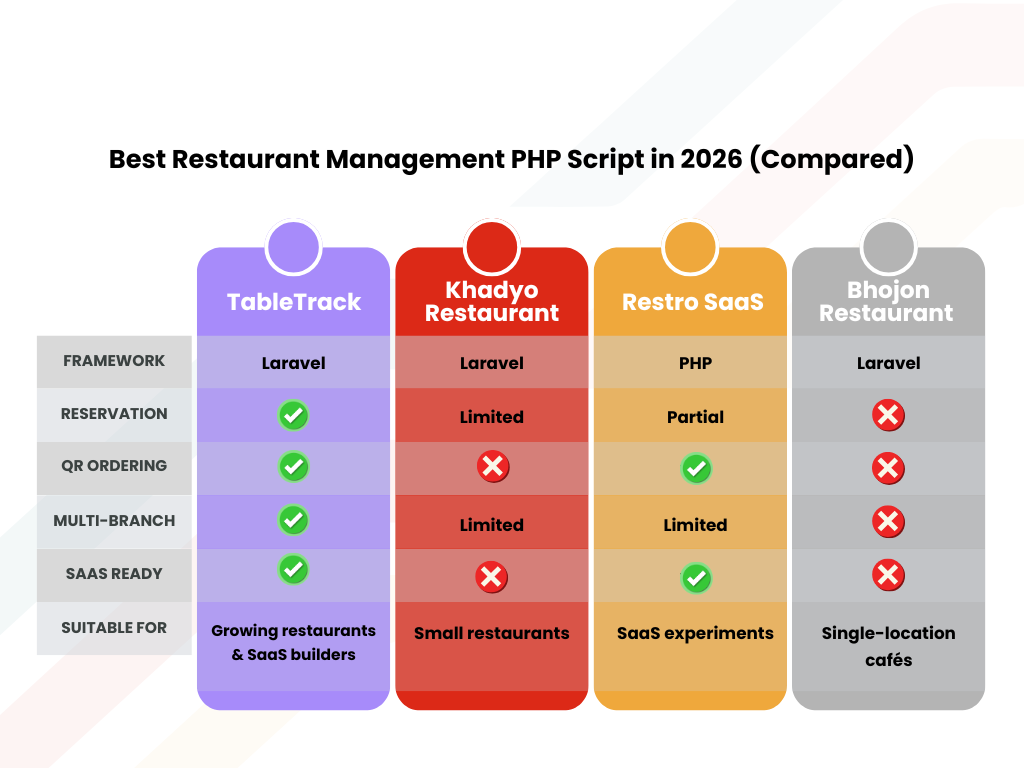
Top PHP Restaurant Management Scripts in 2026 (Quick Comparison)
1. TableTrack (Laravel-Based Restaurant Management Script)
Among newer-generation restaurant management system PHP scripts, TableTrack is designed around workflows that modern restaurants increasingly depend on — especially reservations, QR ordering, and centralized dashboards. Because it is built using Laravel, developers typically find it easier to customize compared with legacy PHP POS scripts.
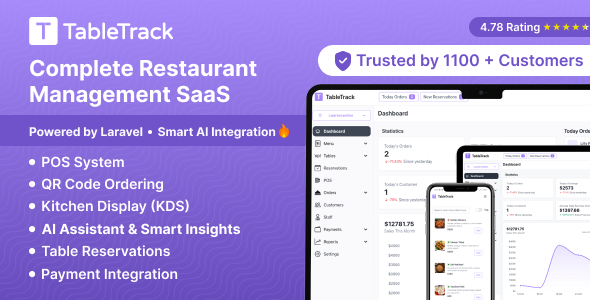
Notable capabilities include
Table reservation workflows
Restaurants can organize seating schedules and reduce wait-time conflicts through structured reservation handling.QR-based menu ordering
Contactless ordering has become common across cafés and dine-in restaurants. Built-in QR ordering helps reduce reliance on manual order-taking.Multi-branch visibility
Instead of managing outlets separately, administrators can monitor multiple restaurant locations through one interface.Admin dashboards
Performance tracking tools make it easier to review daily operations without exporting external reports.SaaS-ready structure
For agencies and developers planning multi-tenant restaurant platforms, this architecture can reduce development overhead.
Rather than focusing only on POS billing, the system covers multiple operational layers, which is increasingly expected from restaurant automation software today.
Website: https://tabletrack.froid.works/?show=demo_landing
2. Khadyo Restaurant POS Script
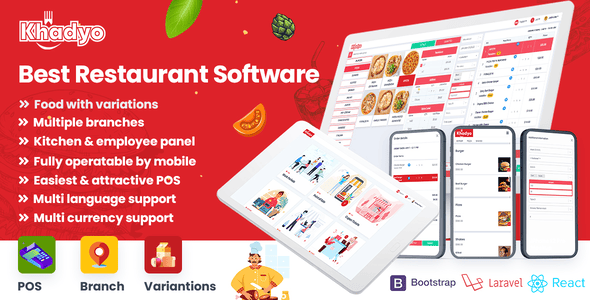
Khadyo is commonly used as a lightweight restaurant POS PHP script for small to mid-sized food businesses that primarily need a structured billing and order-handling workflow. Instead of focusing on advanced automation features, the script is designed to support everyday counter-level restaurant operations.
It is typically suitable for setups such as:
Cafés and coffee shops
Takeaway counters
Quick-service restaurants
Small dine-in outlets with simple workflows
Khadyo often performs effectively in settings where order entry, invoice creation, and menu management are more important than multi-branch reporting or reservation-based seating coordination.
However, restaurants planning to expand their digital infrastructure may eventually need additional modules or integrations.
Website: https://demo.khadyo.com/#menus
3. Restro SaaS Restaurant Platform Script
Restro SaaS is positioned slightly differently from traditional POS-focused restaurant scripts. Instead of being designed only for internal restaurant operations, it is often used by developers or founders exploring multi-restaurant platform or SaaS-based ordering solutions.
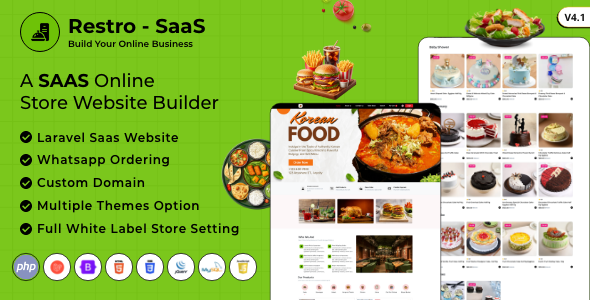
Its structure supports features such as:
multi-restaurant onboarding capability
subscription-based service setup
online ordering workflows
restaurant-specific dashboards
This makes it useful for entrepreneurs planning to test marketplace-style or subscription-based restaurant platforms without building software from scratch.
Website: https://codecanyon.net/item/restro-saas-whatsapp-food-ordering-system/35812107
4. Bhojon Restaurant Management Script
Bhojon is another restaurant management script frequently used for smaller dining setups that need a simple and structured digital workflow for handling orders and billing.
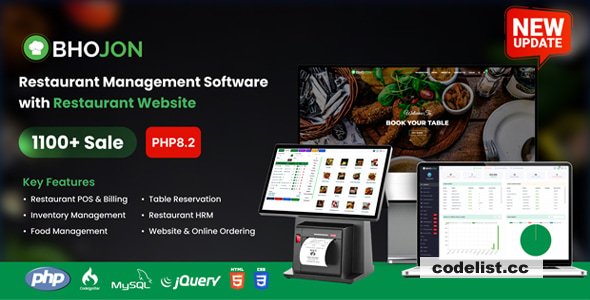
It typically supports core operational features such as:
Invoice generation
Order tracking workflows
Menu configuration and updates
Basic reporting visibility
These features make it suitable for restaurants transitioning from manual billing systems to a digital POS-style setup.
Because of that, it is often selected for straightforward POS environments rather than full-service dining automation.
Choosing the Right PHP Restaurant Script for Your Use Case
Not every restaurant needs the same type of system. Your ideal solution depends on how the software will be used.
For single-location cafés
Basic POS scripts may be sufficient.
For dine-in restaurants with reservations
Reservation-enabled scripts are more practical.
For restaurant chains
Multi-branch dashboards become essential.
For developers building SaaS platforms
Multi-tenant architecture and customisation flexibility matter most.
This is why Laravel-based restaurant scripts are increasingly preferred in 2026.
Why Laravel-Based Restaurant Scripts Are Becoming Standard in 2026
In recent years, many modern restaurant management system PHP scripts have shifted from traditional core PHP development to frameworks like Laravel. Earlier POS tools focused mainly on billing and order entry, but today’s systems are expected to support table reservations, QR ordering, analytics dashboards, mobile access, APIs, and multi-branch management.
Easier Integrations with Modern Tools
Restaurants increasingly connect their systems with services such as:
Payment gateways
SMS or WhatsApp alerts
Accounting platforms
Delivery tools
Analytics dashboards
Laravel’s API-friendly structure makes these integrations easier without major redevelopment.
Better Support for Mobile and SaaS Expansion
Modern restaurant operations often involve mobile ordering interfaces and multi-device dashboards. Laravel supports API-based workflows that help teams:
Connect mobile apps
Enable customer ordering portals
Support handheld waiter devices
Build multi-restaurant SaaS platforms
When Should You Use a Self-Hosted Restaurant Management Script?
A self-hosted restaurant management system PHP script is a practical choice for businesses and developers who want more control over their software than typical cloud-based platforms offer. Instead of relying entirely on third-party tools, self-hosted solutions allow teams to customize workflows, manage their own hosting environment, and scale the system as their operations grow.
These scripts are especially useful for:
Restaurant chains managing multiple locations
Multi-branch restaurants often need centralized dashboards, custom reporting, and branch-level staff permissions. Self-hosted systems make it easier to control operations across outlets from a single platform.Agencies managing multiple restaurant clients
Digital agencies working with hospitality businesses can deploy separate installations, customize features for each client, and maintain technical control over updates and integrations.SaaS founders building restaurant platforms
Entrepreneurs launching multi-restaurant platforms often start with self-hosted scripts to reduce development time and test subscription-based service models more efficiently.Developers building customized workflows
Restaurants with reservation-heavy setups, QR ordering environments, or specialized reporting needs benefit from source-code access that allows deeper customization.
Compared with cloud-only solutions, self-hosted restaurant scripts provide greater flexibility, branding control, and long-term scalability for growing restaurant operations.
Final Thoughts: Which PHP Restaurant Script Is the Most Practical in 2026?
There isn’t a single universal solution that works for every restaurant setup.
However, when comparing reservation support, QR ordering workflows, dashboard visibility, and multi-branch readiness together, newer Laravel-based platforms such as TableTrack are increasingly aligned with how restaurants operate today.
For smaller setups, simpler POS-focused scripts may still be sufficient. But for restaurants planning digital ordering workflows or centralized outlet management, choosing a more complete restaurant automation system early can reduce future migration effort.